What is the Early Years Foundation Stage?
Key Takeaways
The Early Years Foundation Stage (EYFS) is the British statutory framework for children from birth to age 5, used in UK schools and adopted by British-curriculum international schools in Bangkok. K1 (ages 3 to 4) and K2 (ages 4 to 5) build language, social skills, motor development, and early literacy and numeracy through play rather than formal lessons. IPS delivers the full EYFS curriculum at its early years international school campuses along Charoen Nakorn Road, and at its Bangkhae campus, with Thai Language and Culture taught alongside.
EYFS appears on most British international school websites in Bangkok, often with very little explanation of what it actually covers. For parents weighing K1 and K2 options, the term carries real implications for how a classroom is set up, what children spend their day doing, and how progress is measured. Nevertheless, its scope is not immediately apparent.
Understanding the practical application of the Early Years Foundation Stage, the British statutory framework for children aged 0-5, enhances the value of school visits. This is what you need to know.
What the Early Years Foundation Stage Actually Is
The Early Years Foundation Stage, or EYFS, is the statutory framework set by the UK Department for Education covering learning, development, and care for children from birth to age 5. It applies to UK nurseries, preschools, and Reception classes, and is adopted by British-curriculum international schools across Asia, including in Bangkok.
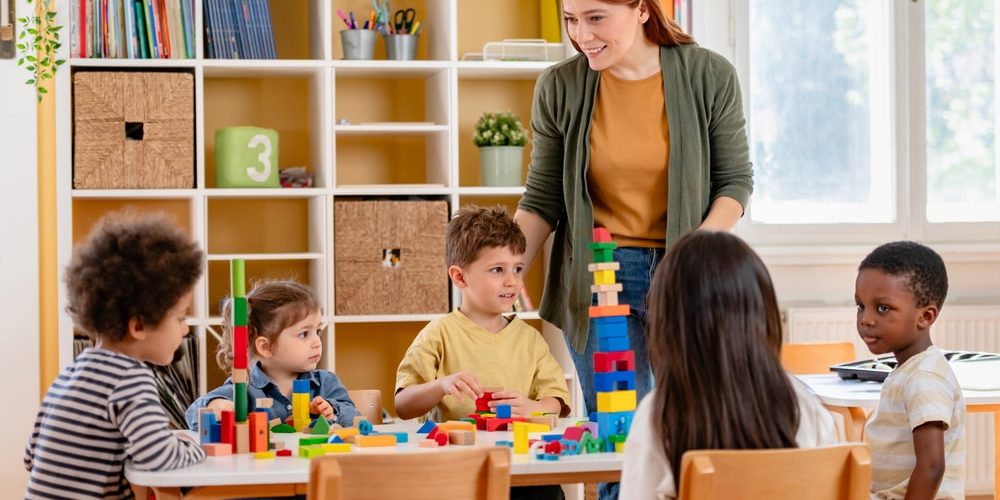
The framework is play-based by design. Young children build language, motor skills, and confidence through exploration and hands-on activity rather than formal lessons at desks. Teachers observe children at work and note progress against early learning goals, so formal testing is replaced with ongoing assessment through photos, learning journals, and structured observations shared with parents.
The Seven Areas of Learning Under EYFS
Under EYFS, the framework organises early learning into seven connected areas, which make up what children learn in K1 and K2:
- Communication and language: listening, speaking, vocabulary.
- Personal, social and emotional development: confidence, friendships, self-regulation.
- Physical development: gross and fine motor skills.
- Literacy: early reading, phonics, name writing.
- Mathematics: numbers, counting, shapes, patterns.
- Understanding the world: nature, communities, simple science.
- Expressive arts and design: art, music, role-play.
The first three are known as the prime areas, and they carry the most weight in K1 because language, social skills, and physical development support everything else children pick up later. The remaining four (the specific areas) build on the prime ones as children move into K2 and beyond.
What Children Learn in K1 (Ages 3 to 4)
K1 is the first proper school year for many children, with the priority being on settling in rather than academic output. Children learn to separate from parents calmly, follow simple classroom routines, take turns, and manage basic self-care like handwashing and tidying up.
Vocabulary builds through stories, songs, and role-play, while children practise expressing needs and feelings in words. Physical development covers gross motor skills (running, climbing, balancing) and fine motor work like crayon grip, threading, and play-dough.
Early literacy and numeracy also start at this stage, but gently, like enjoying picture books, recognising their own name, counting small sets of objects, and exploring shapes through toys and blocks. A typical K1 day moves between free play, outdoor time, circle time, a story, and a hands-on art or sensory activity, with plenty of social play throughout.
What Children Learn in K2 (Ages 4 to 5)
K2 keeps the play-based approach, but expectations step up as children move closer to Year 1. Systematic phonics begins with children learning letter sounds, blending them into simple words, and starting to write their own names and short words using a correct pencil grip.
Mathematics develops, too. Children count reliably past 10, recognise numerals, compare quantities, and work with shapes, positions, and simple measurements. Communication becomes more confident: longer sentences, retelling familiar stories, and listening in group settings such as circle time and show-and-tell.
Kids also gain a better grasp of the world, learning about animals, plants, weather, and basic science concepts such as buoyancy. Age-appropriate use of classroom technology comes in as well. Alongside continued play, K2 children spend more time in structured small-group sessions for phonics and maths, which prepares them for the rhythm of Year 1.
How EYFS Differs From a Traditional Kindergarten
Many traditional kindergartens in Thailand lean towards desk-based work from a young age, with children copying letters and numbers and taking frequent tests. EYFS takes a different path.
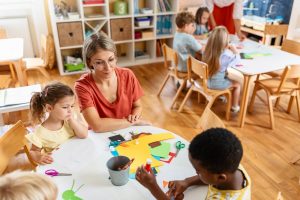
Observation replaces formal testing, and academic skills are built through play rather than drills. Furthermore, social and emotional development is prioritised just as much as literacy and numeracy are. The classroom itself also looks different, as an EYFS room is organised into clear learning areas (a reading corner, role-play space, blocks, art station, sensory tray) rather than rows of desks facing the front.
At IPS, both K1 and K2 classrooms at our Krungthonburi and Bangkhae campuses are set up around this approach. Learning areas are clearly defined for reading, role-play, art, and hands-on discovery, with a mix of indoor and outdoor spaces so your child can move between focused work and active exploration throughout the day.
Checklist for Visiting an EYFS Classroom
School tours are the best way to see how EYFS plays out in practice. Signs that a child will have a good learning journey include:
- Learning materials: age-appropriate, safe, durable, and engaging materials that support children’s learning through play and active exploration.
- Qualified staff: teachers and practitioners who understand child development and build positive relationships with children and families.
- Balanced curriculum: a broad range of play-based experiences across all seven EYFS areas to support overall development.
- Ongoing observation: progress tracked through photos, learning journals, and regular parent updates rather than formal grades.
- Outdoor learning: Outdoor time built into the daily schedule for physical development and hands-on discovery.
- Local grounding: Thai language and culture taught alongside EYFS for families based in Bangkok.
Talking to current K1 and K2 parents often gives a clearer picture, especially around teacher consistency and how the school communicates progress.
Enrol for EYFS at International Pioneers School
EYFS gives children from ages 3 to 5 a foundation built through play, observation, and the seven areas of learning, with K1 settling them into school life and K2 preparing them for Year 1. Nevertheless, the framework’s effectiveness hinges on the school’s implementation, making the school’s environment, teaching methods, and curriculum delivery just as crucial as the written framework.
IPS has been delivering British-curriculum education in Bangkok since 1998 across two campuses, with WASC and ONESQA accreditation backing our EYFS programme. All seven areas of learning are taught hands-on, alongside a dedicated Thai Language and Culture component that keeps your children grounded in the local context.
Play-based learning at IPS supports progression and academic development by building your child’s curiosity, critical thinking, communication, creativity, and problem-solving skills, laying a strong foundation for future academic success.
Explore our early-years international school in Charoen Nakorn programme for families on the Thonburi side. If you are near Phetkasem, take a closer look at our early-years international school in the Bangkhae campus. Admissions are open year-round.
References
- Early Years Foundation Stage Statutory Framework. Retrieved 5 June 2026, from https://www.gov.uk/government/publications/early-years-foundation-stage-framework–2
Frequently Asked Questions About EYFS
Q1: What is the Early Years Foundation Stage in simple terms?
A: EYFS is the British framework for children from birth to age 5. It covers learning, development, and care, and uses play-based teaching rather than formal lessons. UK nurseries, Reception classes, and many British-curriculum international schools in Bangkok follow it.
Q2: What do children learn in K1 and K2 under EYFS?
A: K1 (ages 3 to 4) focuses on settling in, vocabulary, social skills, motor development, and basic literacy and numeracy through play. K2 (ages 4 to 5) builds on this with systematic phonics, early writing, counting beyond 10, and more structured small-group sessions ahead of Year 1.
Q3: How is EYFS different from a traditional Thai kindergarten?
A: Traditional Thai kindergartens often start desk-based academic work early, with frequent testing. EYFS prioritises observation over testing and builds skills through play and exploration. Social and emotional development is weighted just as much as literacy and numeracy are.
Q4: What age groups does EYFS cover at IPS?
A: At IPS, EYFS covers Kindergarten 1 (ages 3 to 4) and Kindergarten 2 (ages 4 to 5). Both the Krungthonburi and Bangkhae campuses run the same EYFS curriculum based on the British Statutory Framework.
Q5: Does IPS teach Thai language during EYFS?
A: Yes. Thai Language and Culture is taught alongside the seven EYFS areas of learning at both Krungthonburi and Bangkhae campuses. This keeps children grounded in the local context while building the British curriculum foundations.